


A provisional improvement notice (PIN) is an important tool which enables trained HSRs to resolve work health and safety issues in the workplace.
A PIN can be used if consultation between the HSR and their employer does not resolve the issue when, in their opinion, WHS laws are being contravened.
If a WHS issue arises that involves an immediate threat to anyone’s health or safety, a PIN may not be an appropriate way to address the issue and the HSR and work may need to be directed to cease. See Stopping unsafe work for more information regarding a HSRs power to directing unsafe work to cease.
Watch our video on how to issue a Provisional Improvement Notice:
What is a PIN
A PIN is a legal document instructing the relevant duty holder, usually an employer, to address a WHS issue that a HSR believes contravenes the WHS Act or Regulations.
Who can issue a PIN
A PIN can only be issued by an elected HSR (or deputy HSR when acting in the role of HSR) who has completed their initial approved 5-day training, also known as Level 1 training.
All HSRs are entitled to undertake this training in their first year of office.
Who a PIN can be issued to
A HSR can issue a PIN to any person who has duties under the WHS Act or Regulations in accordance with section 209 of the WHS Act, including:
- an employer, which can be either an organisation or an individual
- a person with management or control of the workplace.
A ‘person’ may be a body corporate, an unincorporated association, a partnership, or an individual. The person does not necessarily have to be present at the HSR’s workplace. For example, they may be a designer, a manufacturer, or a supplier of plant, substances, or structures.
A PIN can be given to the person it’s issued to by:
- delivering it personally or sending it by post or digitally,
- leaving it for the person at their last known place of residence or business (with someone that resides/works there and is over 16yrs),
- leaving it for the person at the workplace the notice relates to with a person who has management or control of the workplace (e.g. manager or supervisor)
When a PIN can be issued
If a HSR reasonably believes that a person is contravening a provision of the WHS Act or Regulations or has contravened a provision in circumstances that make it likely that the contravention will continue or be repeated, the HSR can issue a PIN.
Examples of contraventions that could be likely to continue or likely to be repeated may include:
- an ongoing requirement to manually lift heavy objects
- machinery used in the workplace that has been found to exceed safe noise levels and no safe alternative has been arranged
- regular exposure to hazardous chemicals that are used in the workplace
- unguarded machines
- poor organisational change management
- a PCBU not consulting about a WHS matter when it is reasonably practicable to do so
- if there is more than one contravention, a separate PIN must be written for each contravention
However, the HSR must first consult with the duty holder responsible for remedying the issue and allow reasonable time for the matter to be resolved.
If the matter is not resolved within a reasonably practicable timeframe, a PIN may be issued.
Consultation
Consultation must take place between the HSR and the duty holder they believe is contravening the WHS Act or Regulations. Consultation allows everyone involved to discuss their concerns and may also result in the issue being resolved before a PIN is issued or involving SafeWork SA.
If consultation does not occur before a PIN is issued, the PIN will not meet the requirements of the WHS Act.
HSRs should:
- provide information, either verbally or in writing, about fixing the alleged contravention or activities causing the contravention
- give the person an opportunity to express their views and take those views into account
- allow adequate time for the contravention to be fixed.
It will be considered that consultation has taken place even if:
- there is no response within a reasonable time, or not at all
- no agreement has been reached on the contravention and how to fix it.
Issuing a PIN
It is not compulsory to use a specific form, although you may wish to use our template to ensure the required information is included.
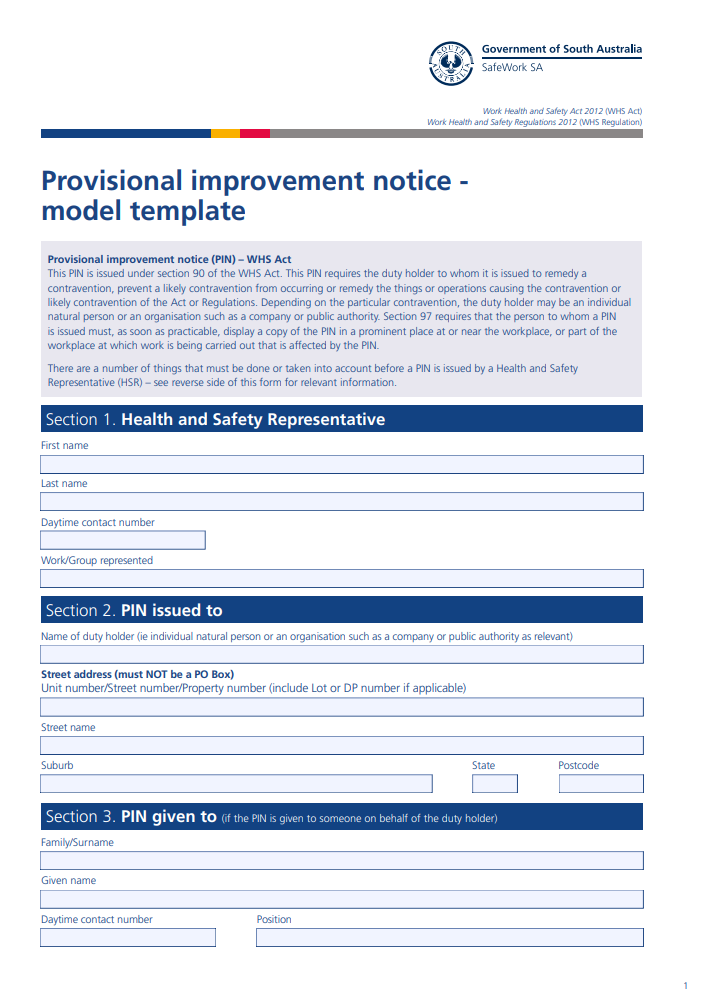
Image: Sample of the Provisional Improvement Notice - model template
If there is more than one contravention, a separate PIN must be written for each.
A PIN must:
- be in writing
- state the reasons why the HSR considers the laws are being contravened, or the contravention is likely to continue or be repeated
- specify the provision of the WHS Act or Regulations that are being contravened, or likely to be contravened
- specify a time limit of at least 8 days after the date of issue for the contravention to be remedied.
The HSR may include directions on how to remedy the matter, however, is not required to do so.
PINs cannot be issued for matters already being addressed by one of our inspectors through Improvement or Prohibition Notices.
Complying with a PIN
The recipient for a PIN must display the notice in a prominent place close to the affected workers and/or parts of the workplace(s); and either:
- comply with it within the specified time frame or if no date has been specified, as soon as practicable; or
- request SafeWork SA appoint an inspector to review the PIN within 7 days of the PIN being issued.
PINs must not be intentionally removed, damaged or defaced while they are in force.
A PIN remains in force until the matter has been resolved. However, the HSR who issued it may cancel it, by written notice, at any time.
Non-compliance with a PIN
If a PIN is not complied with in the specified timeframe, the HSR can contact SafeWork SA and request for an inspector to be appointed to address the non-compliance, which may lead to further action taken by the regulator.
Reviewing a PIN
The person issued with a PIN, or their employer if they are a worker, can ask SafeWork SA to appoint an inspector to review the notice. This request must be made within 7 days of when the PIN was first issued. An inspector will enquire into the circumstances of the PIN to determine whether it meets the requirements as per the WHS Act and that the directions are reasonably practicable to be met.
After the inspector has reviewed the PIN, they may either:
- confirm the PIN as is
- confirm the PIN with changes
- cancel the PIN
This decision is a reviewable decision listed in the WHS Act.
Support
If you have questions about PINs you can contact the SafeWork SA HSR Advisor by emailing HSR.Safework@sa.gov.au, or by seeking assistance from other HSRs, or your union.
You may also refer to the information and guidance provided within the HSR Handbook.